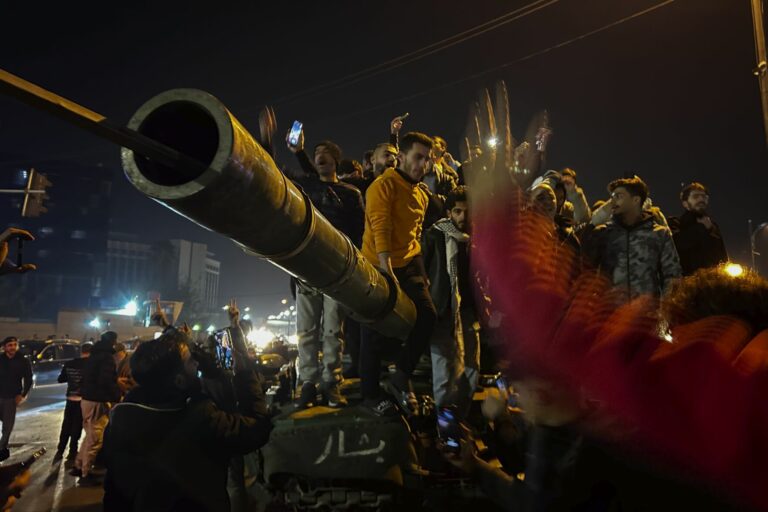
**DAMASCUS, Syria (AP)** — Bashar Assad, the ousted Syrian leader, has fled to Moscow where he has been granted asylum by his longtime ally, as reported by Russian media on Sunday. This comes just hours after a surprising rebel takeover in Damascus, effectively ending his family’s five-decade rule. Thousands of Syrians took to the streets amid celebratory gunfire, waving the revolutionary flag, in scenes reminiscent of the early Arab Spring uprisings—before the subsequent crackdown and rise of an insurgency plunged the nation into a conflict that lasted nearly 14 years.
These rapid developments have sparked questions about Syria’s and the region’s future.
“Our approach has shifted the balance of power in the Middle East,” President Joe Biden remarked, attributing the weakening of Syria’s allies—Russia, Iran, and Hezbollah—to actions by the U.S. and its partners. He hailed Assad’s fall as a “fundamental act of justice,” while acknowledging the accompanying “risk and uncertainty.” Biden noted that the U.S. would evaluate the actions of rebel groups, although they are “saying the right things now.”
Russia has requested an emergency U.N. Security Council session to discuss Syria, according to Dmitry Polyansky, the country’s deputy ambassador to the U.N.
Russian media agencies Tass and RIA have reported Assad’s arrival in Moscow, citing an unnamed Kremlin source. A spokesman from Russia did not immediately comment. RIA also reported that Syrian insurgents have guaranteed the security of Russian military posts in Syria.
Prior to this, Russia indicated that Assad left Syria following talks with rebel groups and had initiated a peaceful power transfer. Abu Mohammed al-Golani, the head of Syria’s prominent rebel faction, is poised to decide the country’s future. Previously an al-Qaida commander, he severed ties with the group years ago and now advocates for pluralism and religious tolerance. However, his group, Hayat Tahrir al-Sham (HTS), is still labeled a terrorist organization by the U.S. and the U.N.
In his first public appearance since the Damascus suburbs were taken over, al-Golani visited the Umayyad Mosque, describing Assad’s ousting as “a victory for the Islamic nation.” Identifying himself by his real name, Ahmad al-Sharaa, he criticized Assad for turning Syria into “a farm for Iran’s greed.”
Rebels now face the daunting challenge of reunifying a war-torn country fragmented among armed factions. In the north, Turkey-supported opposition fighters are clashing with U.S.-allied Kurdish forces, while the Islamic State group remains active in remote parts.
Syrian state TV broadcast a message from the rebels declaring Assad overthrown, all prisoners freed, and imposed a curfew in Damascus from 4 p.m. to 5 a.m. An online video showed rebels allegedly freeing women from Saydnaya prison, infamous for reports of torture and killings.
“This happiness will not be complete until I can see my son out of prison,” said Bassam Masr, searching for his son who has been detained for 13 years.
Rebel commander Anas Salkhadi, appearing on state TV, reassured religious and ethnic minorities of their safety, proclaiming, “Syria is for everyone, no exceptions.”
**Celebrations and Challenges in Damascus**
In Damascus, residents prayed, celebrated, chanted anti-Assad slogans, and honked car horns. Security forces abandoned their posts, and looters broke into the Defense Ministry. Some families wandered through the presidential palace past damaged Assad portraits.
“It feels like a dream,” said opposition fighter Abu Laith, noting the warm reception rebels received. Rebels have secured key sites like the Justice Ministry.
The pro-government newspaper al-Watan said the day marked “a new page for Syria” and called for understanding towards past media publications. The Alawite sect, which was central to Assad’s support, urged young Syrians to remain calm and rational.
**Calls for Orderly Transition**
The recent rebel gains, including capturing Aleppo, Hama, and Homs, reflect the largest advances in recent years. Russia, Iran, and Hezbollah, pivotal in supporting Assad, have distanced themselves amid other conflicts. Iran, hard-hit by recent hostilities with Israel, stated Syrians should determine their future “without destructive, coercive, foreign intervention.”
Iranian officials confirmed Syria’s decision for a peaceful power transfer after realizing the rebels’ military superiority. Iran is apprehensive about potential civil war and Syria’s potential collapse.
Syrian Prime Minister Mohammed Ghazi Jalali indicated the government’s willingness to establish a transitional government. U.N. special envoy for Syria, Geir Pedersen, has urged talks in Geneva to ensure a political transition.
In a related move, Qatar held an emergency meeting of foreign ministers and officials from eight countries. Israel seized an area in the Golan Heights for claimed protection post-Assad era.
**Global and Regional Reactions**
This dramatic shift has sent ripples through global politics, drawing comments and concerns from various nations including Iran, Israel, and Qatar, highlighting the situation’s volatility.
By highlighting the complexities and international response surrounding Assad’s departure, this description captures the unfolding geopolitical landscape in the Middle East.