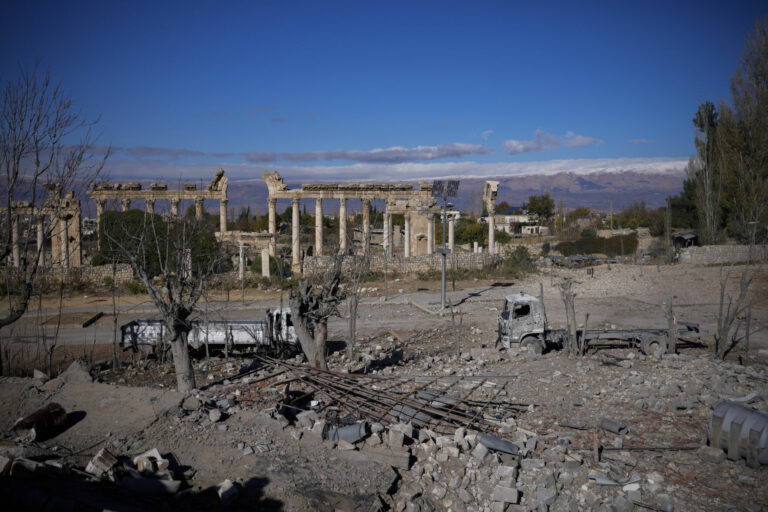
BEIRUT (AP) — On Thursday, Israel conducted its first airstrike on Lebanon since announcing a truce with Hezbollah. The strike was aimed at a Hezbollah rocket storage facility in southern Lebanon, allegedly violating the ceasefire. Lebanese authorities reported several incidents of Israeli attacks, including mortars and gunfire, leaving two individuals wounded. While Lebanese media identified the wounded as civilians, Israeli military labeled them as suspects breaching the truce terms. Despite this violence, the ceasefire largely held as Lebanese troops were deployed in parts of southern Lebanon, the Bekaa Valley, and southern Beirut suburbs where Hezbollah operates.
The Lebanese military began clearing unexploded ordnance and set up temporary checkpoints to facilitate the return of displaced civilians. Approximately 1.2 million people were displaced during Lebanon’s deadliest war in decades, beginning their journey back to their towns, still wary of areas where Israeli troops remain present.
On Thursday, the Israeli military reported opening fire on “several suspects” arriving in vehicles in prohibited southern Lebanon regions, offering no additional details. Lebanon’s state-run National News Agency noted Israeli actions in Markaba, near the border, resulting in civilian injuries and reported Israeli tank fire causing no casualties.
Col. Avichay Adraee, spokesman for the Israeli military, stated that a nighttime curfew south of the Litani River remained in effect for Lebanese residents, from 5 p.m. Thursday until 7 a.m. Friday. The Lebanese army accused Israel of multiple ceasefire violations, involving strikes with diverse weapons and continuous aerial surveillance, coordinating these infringements with relevant authorities.
Associated Press reporters in northern Israel heard drones and sporadic machine-gun fire in Lebanon. Although Hezbollah has yet to comment publicly on the alleged truce violations, their lawmaker Hassan Fadlallah acknowledged the incidents, stating, “We don’t want to rush things,” while affirming Hezbollah’s right to self-defense.
Brokered by the United States and France, the truce between Israel and Iran-backed Hezbollah requires a two-month ceasefire, with Hezbollah retreating north of the Litani River as Israeli forces withdraw to their border. Lebanese troops will gradually assume positions further south as part of the agreement. A buffer zone will be patrolled by U.N. peacekeepers and Lebanese troops, who weren’t involved in the conflict.
Lebanon’s military shared images of soldiers clearing debris, destroyed vehicles, and unexploded bombs from roads. Many Lebanese experienced mixed emotions of relief and heartbreak as they returned home to war-damaged properties.
Drone footage captured on Thursday revealed extensive destruction in Qana, a town synonymous with civilian casualties in past conflicts. Residents reflected on past tragedies, with some reiterating their resolve to rebuild despite recurring devastation from Israeli strikes.
Israel plans to withdraw forces upon confirming Hezbollah’s adherence to the truce, with Lt. Gen. Herzl Halevi emphasizing enforcement through force if necessary. Halevi stressed the importance of allowing approximately 50,000 displaced Israeli residents to return, though for now, Israeli border towns remained quieter compared to the turmoil of recent months.
In Menara, Israel, damaged homes stood testament to recent conflicts, with residents gathering their belongings and leaving the area again. The overall reduction in violence since Hezbollah’s solidarity attacks with Hamas on October 7 marks a notable shift, though conflict lingers in Gaza and northern Israel, with significant casualties reported on both sides.
Reporting contributes from AP writers Natalie Melzer in Nahariya, Israel, and Isabel DeBre in La Paz, Bolivia, alongside Frankel in Menara, Israel. Further coverage of the Israel-Hamas conflict is available at https://apnews.com/hub/israel-hamas-war.